
Talladega Scheduled vs Actual Release
A projected date is a planning date, not proof that a person has already been released. In Alabama's state-prison terminology, the key public phrase is "Minimum Release Date." ADOC defines that as the earliest scheduled date an inmate can be released to probation or end of sentence. ADOC also warns that the date can change because of disciplinary action that removes good time, new cases from the circuit clerk, or changes to the current sentence.
Important distinction. A Talladega County Jail release date is not computed the same way as an ADOC prison date. For a pretrial county detainee, release may depend on bond, recognizance, a judge's order, dismissal, another agency pick-up, or transfer. No Talladega-specific public county formula for jail good time was found in the research sweep, so a page should not invent one. For a county case, ask the jail and court about the specific booking, sentence, bond order, and release order.
| Date phrase | What it means |
|---|---|
| Minimum Release Date | ADOC's earliest scheduled date for release to probation or end of sentence, subject to change. |
| Parole Consideration Date | A tentative parole-board processing milestone, not a guaranteed release date or guaranteed hearing month. |
| Actual jail release | The point when the sheriff no longer holds the person on that booking, which may be release to the community or transfer to another authority. |
| Mandatory supervision date | A statutory state-prison release-to-supervision calculation under Ala. Code Section 15-22-26.2 for eligible inmates. |
Find a Talladega Release Date
The correct lookup path depends on whether the person is in the Talladega County Jail, ADOC custody, federal custody, or supervision. Do not treat a missing ADOC result as proof of release. ADOC says the public database contains currently incarcerated inmates and that historical data is not available online. That limitation is especially important for Childersburg Community-Based Facility / Community Work Center, which is physically in Talladega County but belongs to ADOC.
- For a recent county-jail release, open the Talladega County Sheriff's Office Citizen Connect "Inmate Confinements" page and use "Releases by Date Range." The release-search tool has Last 24 hours, Last 7 days, custom date range, and a 31-day maximum range note.
- If the person may still be in the county jail, compare "Current Confinements" with the release-date-range tab. A released person usually drops off the current list.
- For an ADOC prisoner, search by AIS number if possible. ADOC says the AIS number is the quickest way to find one inmate; name searching is open-ended and common names can hit the 50-result limit.
- Capture any current ADOC fields before release, including facility, offense, Minimum Release Date, Parole Consideration Date, and Parole Status where shown.
- Use the Talladega County court docket to see whether a bond order, sentence, probation order, dismissal, revocation, or transfer explains the date.
- If parole or mandatory supervision applies, check ABPP hearing results, hearing minutes, local field offices, and public-record channels.
- If the person was at FCI Talladega, use the BOP Inmate Locator rather than the sheriff or ADOC. BOP records federal inmates from 1982 forward and uses "Released" for people no longer in BOP custody.
ADOC's definitions page is the source for Minimum Release Date and parole-status terminology.
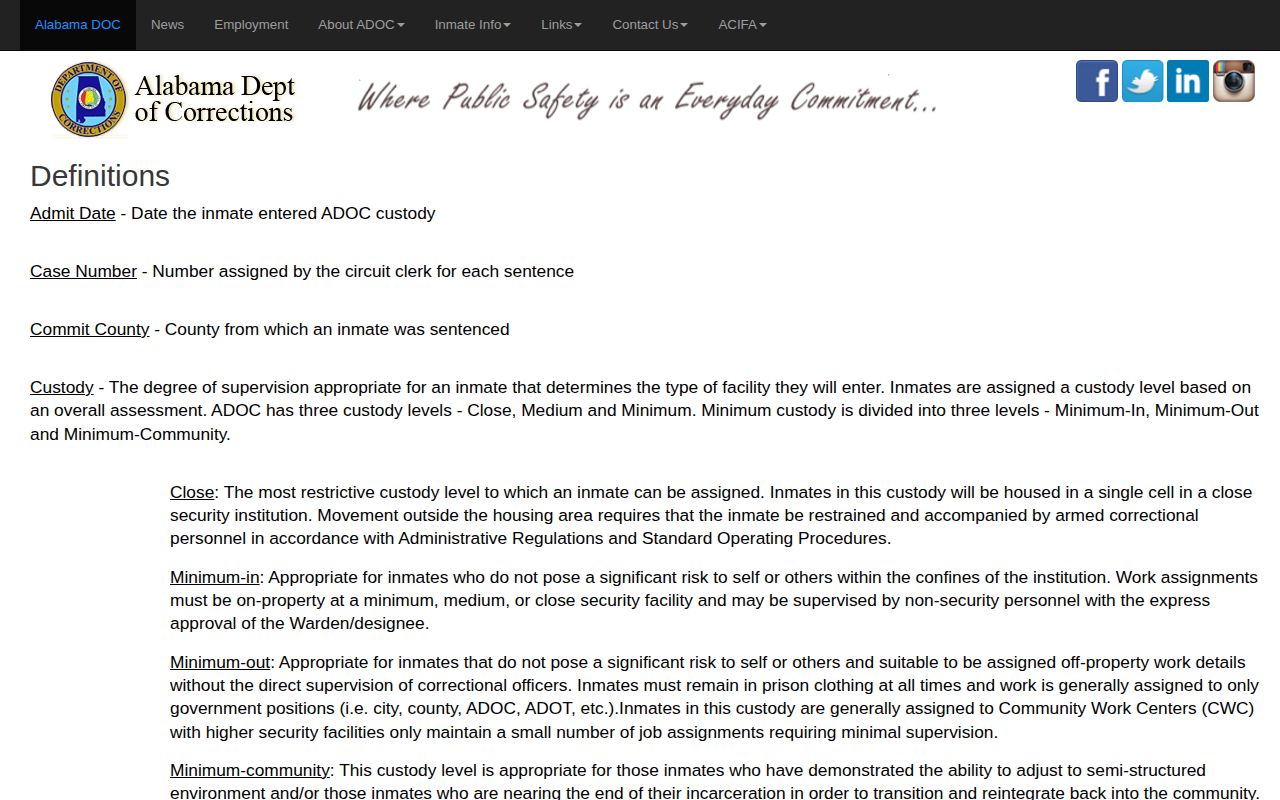
Use ADOC terminology when the person is a state prisoner, then verify any actual release through ADOC records, ABPP, VNS, or court records once the public current-custody profile is gone.
Alabama Good-Time Release Credits
Alabama correctional incentive time is governed by Ala. Code Section 14-9-41. The research summary identifies four earning classes: Class I earns 30 days deduction for each 30 days actually served; Class II earns 15 days for each 30 days; Class III earns 5 days for each 30 days; and Class IV earns none. Class IV is often described as flat time or day-for-day.
Those credits are not universal. The statute has exclusions, including Class A felony convictions, certain deadly-weapon crimes causing death, life or death sentences, sentences over 15 years, and sex offenses involving a child. Eligibility depends on sentence, offense, custody classification, discipline, and statutory exclusions. That is why a public page can explain the categories but should not calculate a case-specific release date without the official sentence and custody record.
Education incentive time is separate. Ala. Code Section 14-9-64 allows education incentive deductions and caps them at 12 months during a term of incarceration. The statute says those deductions are in addition to other available sentence deductions, including correctional incentive time. In practice, projected dates can move in either direction: credits may advance a date, while disciplinary loss of good time, new cases, or sentence changes may push it later.
Talladega Parole Is Not Release
Parole consideration date is a common source of confusion. ADOC defines it as a tentative date set by the parole board. ABPP says eligibility is calculated under Ala. Code Section 15-22-28(e), and the sentence, crime, jail credit, good-time eligibility, time served, and sentencing-court orders can all affect eligibility. A set date does not guarantee a hearing during that exact month; it means the file can be processed once eligibility is reached.
If parole is granted, ABPP still verifies the home plan and coordinates with ADOC to schedule release. A grant is an important decision, but it is not the same as physical release from custody. The ABPP results page may show grant, denial, continuation, reset information, or a path to hearing minutes with special conditions. For local supervision after release, use the Talladega and Sylacauga field offices covered on Post-Release Supervision.
Mandatory supervision is another state release layer under Ala. Code Section 15-22-26.2. ABPP's FAQ says it applies to eligible inmates with offenses committed on or after January 30, 2016, excluding child sex offenses and life sentences. It describes release-to-supervision ranges before end of sentence: three to five months for sentences of five years or less, six to nine months for more than five but less than ten years, and twelve to twenty-four months for ten years or more. ADOC determines the mandatory release date and coordinates with ABPP.
Talladega Jail Dates Differ
The Talladega County Jail release-date-range tool is an event lookup, not a sentence calculator. It can show that a county booking ended within the selected range, but the release reason may require more records. A result can reflect bond, time served, court order, dismissal, transfer to ADOC, another county, federal custody, ICE processing, or another agency pick-up. A transfer can end the county booking without ending all custody.
The public release search has a concrete access boundary: date ranges must be 31 days or less. That is not the same as saying the sheriff deletes records after 31 days. It means older online verification may require smaller date-range searches, a name search, court docket review, or a direct records request. If timing is critical, call or request records from the sheriff because online jail feeds can lag physical release processing.
When the person was held on a Talladega County case, Alacourt and the 29th Judicial Circuit record can explain why the release happened. Look for bond order, release order, sentencing order, jail credit, split sentence, probation order, dismissal, revocation activity, or transfer language. The jail record answers when the booking ended; the court record answers what legal order caused it.
Why Talladega Release Dates Change
A changed release date does not automatically mean the first record was wrong. In Alabama, the official date can move because the legal sentence, custody credits, supervision decision, or receiving agency changed.
| Factor | How it can change the date |
|---|---|
| Discipline | ADOC says the Minimum Release Date can change if disciplinary action takes away good time. |
| New or changed court information | ADOC says new cases or sentence changes sent by the circuit clerk can alter the current sentence calculation. |
| Correctional incentive time | Eligibility class, exclusions, custody status, and conduct affect whether Section 14-9-41 credits apply. |
| Education incentive time | Section 14-9-64 credits may reduce time where available, capped at 12 months during a term. |
| Parole processing | A parole consideration date is a review milestone. A grant still requires home-plan verification and ADOC coordination. |
| Detainer or transfer | A county jail release can mean transfer to ADOC, another county, federal custody, ICE, or another authority rather than unrestricted release. |
| Local court order | Bond, dismissal, time served, probation, split sentence, or community corrections can explain why a county detainee leaves jail. |
Confirm Talladega Actual Release
For the Talladega County Jail, confirm through the sheriff's Citizen Connect release-date-range search, then request the booking or release record if the online result is missing, older, or ambiguous. A useful request identifies the person's full name, date of birth if known, booking date or date range, approximate release date, arresting agency, charges, and the records requested. Ask for the booking sheet, release entry, release date and time, release reason or type, bond or court order reference if public, and transfer destination if the person was transferred.
For ADOC release or discharge records, use ADOC public records. The research notes that ADOC viewing appointments may be available between 9:00 a.m. and 3:00 p.m. Monday through Friday except holidays, that some records are copying-only, and that production cost is paid by cashier's check or money order before copies are produced. ADOC public-record questions route through public.records@doc.alabama.gov and (334) 353-3883.
For alerts, use VINE Inmate Check and Alabama VNS where the person is covered. Treat alerts as custody-status notifications, then confirm the legal record through the sheriff, ADOC, ABPP, BOP, or the court that handled the case.
For federal release from FCI Talladega, the county and ADOC tools are the wrong primary systems. Search BOP by name or register number. BOP says its locator covers federal inmates from 1982 to the present and that "Released" means no longer in BOP custody. A BOP release date does not prove anything about a separate county warrant, Alabama parole matter, ICE detainer, or state court obligation, so reconcile federal results with any local or state records that apply.
For older Alabama state release proof, do not rely on a vanished ADOC public profile. Use ADOC public records, ABPP records if supervision followed, Alabama VNS where the person is eligible, and the sentencing court's disposition. Those sources answer different parts of the timeline: sentence authority, custody movement, supervision start, and final discharge.