
Talladega Parole vs Probation
Parole and probation are often mentioned together because the same state agency may supervise people in the community, but they do not prove the same release event. Parole usually follows a state prison sentence and a decision or statutory release process connected to ADOC and the Alabama Board of Pardons and Paroles. Probation is usually a court sentence or court condition that can happen instead of a longer custody term or after part of a sentence has been served.
For Talladega County, that distinction matters because a released person may have left the Talladega County Jail without ever entering the ADOC parole system. Bond, dismissal, time served, municipal-case processing, a court order, or a local supervision program can end a jail booking. A person released from Childersburg Community-Based Facility / Community Work Center, by contrast, is in the state-prison release lane and may move into ABPP supervision.
| Supervision type | What it usually means | Best verification source |
|---|---|---|
| Parole | Release from an ADOC prison sentence under board authority after eligibility, hearing, grant, and release coordination. | ABPP scheduled hearings, parole results, minutes, local field office, and ADOC records. |
| Probation | A court sentence or condition supervised in the community, sometimes after jail time and sometimes instead of prison. | Talladega County court docket, sentencing order, clerk record, and ABPP field office where applicable. |
| Mandatory supervision | A state release route under Ala. Code Section 15-22-26.2 for eligible ADOC inmates before end of sentence. | ADOC release records, ABPP supervision records, and Alabama VNS if the person is covered. |
| Community corrections | A local court-linked release path that may involve Community Corrections, Court Referral, Bond Supervision, or Veterans Treatment Court. | Court records plus Talladega County Community Corrections, not the parole board alone. |
Definition. A jail release tells you when the sheriff's authority over that booking ended. Post-release supervision tells you whether a court, ABPP, ADOC, or a local program still has conditions after that release.
Verify Talladega Post-Release Supervision
Start with the event you are trying to prove. If the question is whether someone left the county jail, use the Talladega County Sheriff's Office Citizen Connect release-date-range search and court records. If the question is whether a state prisoner moved into parole or mandatory supervision, use ABPP and ADOC sources. If the question is probation after a Talladega County case, the court order is usually the anchor record.
- Check the county release event first. For a Talladega County Jail booking, use the sheriff's Citizen Connect "Releases by Date Range" tab and compare it with "Current Confinements" if the release is recent.
- Review the Talladega County court docket through Alacourt or the 29th Judicial Circuit path to see whether the case ended in bond, sentence, probation, dismissal, transfer, or revocation activity.
- For ADOC custody, use ADOC search only while the person may still be incarcerated. ADOC says its public search contains currently incarcerated inmates and does not provide online historical data.
- Use ABPP hearing pages if parole was involved. The current-year results page and prior-year results can show grant, denial, continuation, reset information, and where minutes may contain special conditions.
- Contact the correct local ABPP office for supervision routing. Talladega North is served by the Talladega Field Office; Talladega South is served by the Sylacauga Field Office.
- Use Alabama VNS or VINELink as a notification channel where the person is covered, then confirm legal proof with the originating agency or court.
ABPP's parole process has one timing nuance that should not be skipped. A parole grant does not mean the person physically walked out that day. ABPP says it must verify the home plan and coordinate with ADOC before scheduling release. For release-date questions tied to a state prisoner, the Release Date Lookup page explains why a Minimum Release Date, parole consideration date, and actual release are separate milestones.
If the person was only in the county jail, verify the jail release before calling a supervision office. ABPP may have no record for a bond-out, dismissal, time-served county sentence, municipal hold, or transfer that never became an ABPP-supervised case.
ABPP Talladega Offices
ABPP does not route all Talladega County supervision questions through one Montgomery contact. The local field-office map splits Talladega County between two offices, which is a useful local detail when a release record says supervision follows.
ABPP publishes the Talladega Field Office page for Talladega North.
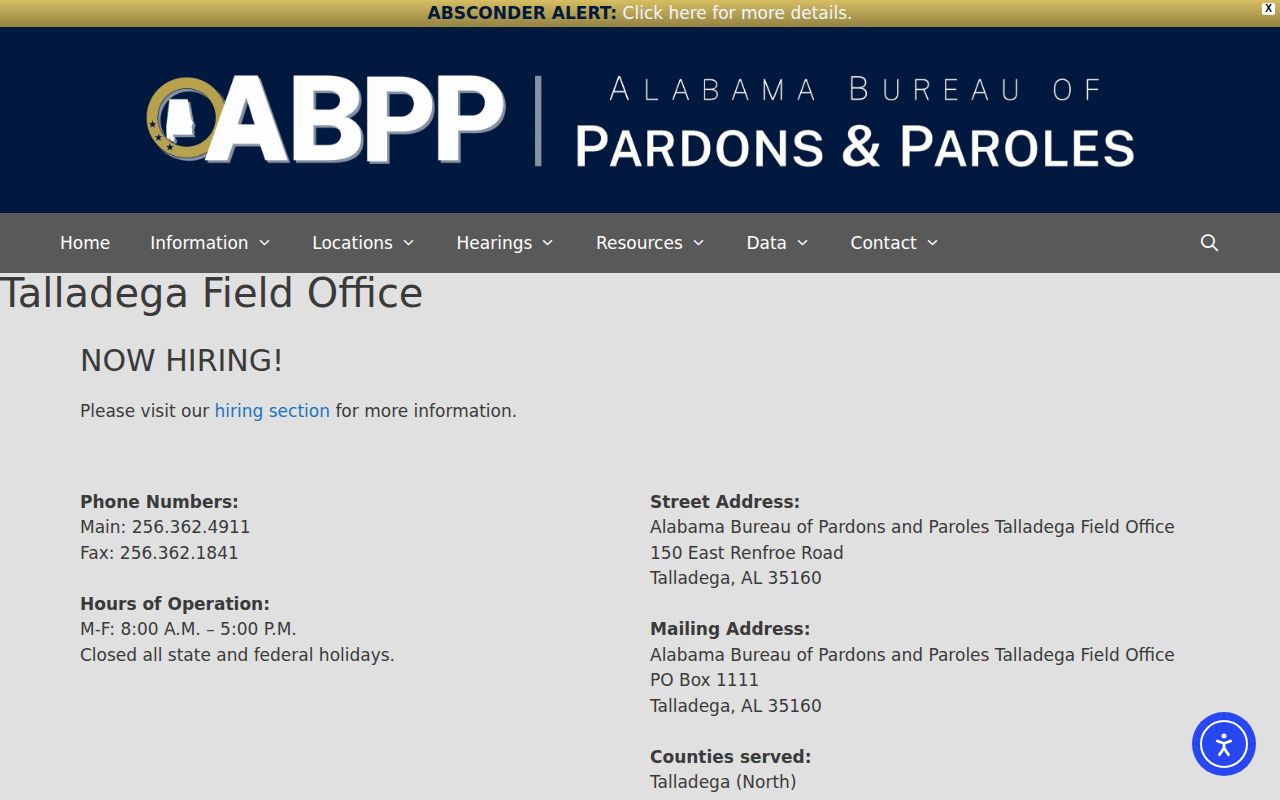
The local office pages are a routing tool, not a jail roster. Use them after you know the person is under ABPP authority or when a court or ADOC record points to ABPP supervision.
| Office | Contact details |
|---|---|
| Talladega Field Office | 150 East Renfroe Road, Talladega, AL 35160. Mailing address: P.O. Box 1111, Talladega, AL 35160. Main phone 256.362.4911; fax 256.362.1841. Hours Monday through Friday, 8:00 a.m. to 5:00 p.m., closed state and federal holidays. Serves Talladega North. |
| Sylacauga Field Office | Room 211, 400 North Norton Avenue, Sylacauga, AL 35150. Main phone 256.249.2597; fax 256.245.8140. Hours Monday through Friday, 8:00 a.m. to 5:00 p.m., closed noon to 1:00 p.m. for lunch and closed state/federal holidays. Serves Talladega South. |
Childersburg Release Context
Childersburg Community-Based Facility / Community Work Center gives Talladega County a state reentry angle that is separate from the county jail. ADOC identifies Childersburg as a minimum-custody community-based facility and community work center at 13501 Plant Road in Childersburg. The facility has male inmates, minimum-community and minimum-out custody classifications, and reentry programming connected to community work and work-center operations.
A person leaving Childersburg should be treated as an ADOC release, parole, mandatory supervision, transfer, or discharge question unless there is also a Talladega County Jail booking. The sheriff's release feed does not prove state-prison release from Childersburg. For that path, check ADOC while the person is current, then use ADOC records, ABPP supervision, Alabama VNS where eligible, and court records to reconcile the release.
Talladega Supervision Absconders
Supervision status can change after release. ABPP may supervise conditions attached to parole, probation, or mandatory supervision; the court may also impose conditions through the underlying case. A public page should not infer a violation from a missed search result. It should separate ordinary supervision from absconder or warrant status.
ABPP maintains a statewide Absconder Alerts channel. In this context, an absconder alert is not just another release listing. It is a public notice that the person is alleged to have violated supervision or reporting requirements, and ABPP directs people with whereabouts information to law enforcement. That status should be verified through ABPP, court records, and law-enforcement channels before drawing any conclusion about a new case.
VINELink and Alabama VNS can help with release or custody-change alerts, but Alabama VNS is narrower than many readers expect. The Alabama VNS page says it is for offenders convicted in Alabama and sentenced to ADOC custody, and it directs pretrial case questions to the sheriff in the county where the crime occurred. For a Talladega County Jail release, the sheriff and court remain the primary verification sources.
Talladega Court Supervision
Talladega County Community Corrections is the local supervision path that can be mistaken for parole. The county describes Community Corrections, Court Referral, Bond Supervision, and Veterans Treatment Court programs. Those programs matter when a person leaves jail under a court-linked order rather than through an ADOC parole decision. The proof source is the court docket and program record, not a parole-hearing result.
When the release entry is unclear, compare three records: the sheriff booking or release entry, the court order that authorized release, and the supervision office or program named in that order. A county release to bond supervision, community corrections, or probation can leave the jail roster looking complete while the underlying case remains active. That is why court records are a durable source after the sheriff's online release date range no longer shows the booking.
How Talladega Supervision Ends
Supervision does not end just because a person is no longer listed in jail or prison custody. A jail release can be followed by probation, community corrections, bond supervision, a pending court date, a transfer, or ABPP supervision. A state release can move into parole or mandatory supervision before final discharge. The cleanest end-of-supervision proof is usually a court order, ABPP record, ADOC discharge record, or official agency response.
Alabama public-records law supports a records-request path, but it does not make every supervision detail public without limits. Juvenile, youthful-offender, sealed, expunged, medical, victim-related, confidential law-enforcement, and other protected information may be withheld or redacted. If the record is older than the online feed, request the booking sheet, release entry, release reason or type, transfer destination if any, and the court or supervision record that explains what happened next. For the broader records path, start with the site's released-inmate search guide on the home page.
For ABPP records, use the public hearing pages first when the issue is parole consideration, results, reset dates, or minutes. Use the field offices for local routing once supervision authority is established. Use a public-record request when you need a record beyond the public pages, and expect privacy limits for active supervision details. For ADOC discharge or release records, ADOC public records is the better route than the current inmate search after release, because ADOC says historical data is not available online.